
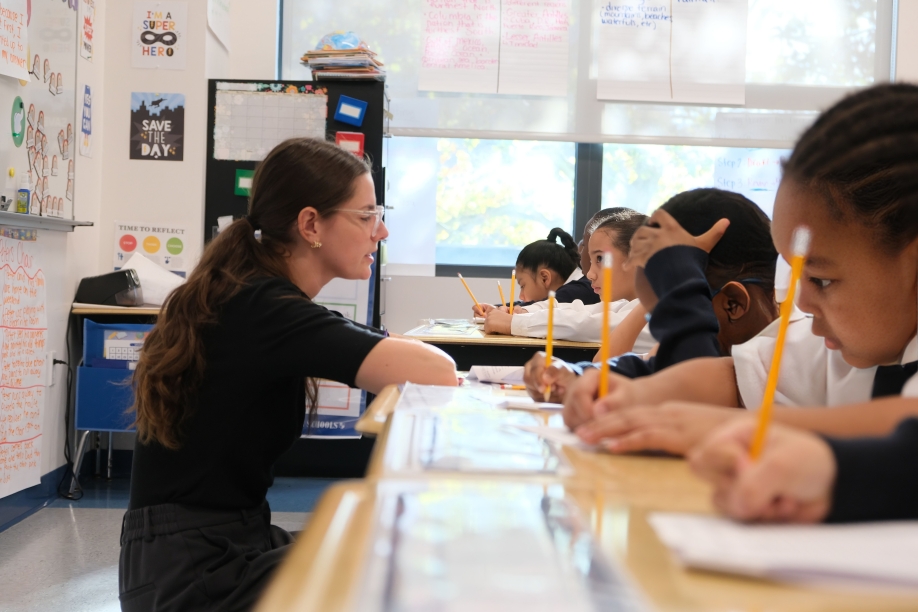
Rome was not built in a day, and neither was any successful classroom. The best classrooms are instead built well before scholars arrive and rebuilt with every expectation that the teacher sets. But this requires a clear vision and constant reinforcement of a teacher’s expectations. At Classical, we prioritize classroom organization, and we organize our classrooms using a few simple steps that can be replicated. The more organized a classroom is, the more scholars can engage in learning safely and productively throughout the day.
Examine the Space
The first step in any classroom design is to examine the space and think of the activities that will take place within the room. All classrooms share the same necessities: scholars can enter, learn, and exit safely day after day. But each classroom is unique in its orientation. So, as a first step, the teacher should examine the space and choose where the scholars will spend most of their time and what activity will occupy each part of it. This division of the room helps highlight for scholars (and for the teacher) that every component of the room should be functional. In general, there are four essential components: 1) the learning space (where class takes place including the desks and board), 2) the materials space (where scholars can interact with the classroom and its theme), 3) the teacher space (where the teacher keeps their materials), and 4) flex space (where scholars when not learning can relax).
Establish Boundaries
After a teacher has decided on the division of their room’s space, they should establish the rules of movement throughout the classroom. Some helpful questions that a teacher can ask themselves are: where will scholars have to go, where might scholars have to go, and where should scholars not go? When a teacher has answers to these three questions, they can start to organize the room mentally. For example, scholars will always have to enter and exit, so how should they do that? Scholars will also need to be able to get tissues or pencils or go to the bathroom. In each of those scenarios, how do those scholars move? Where will you set aside space so that scholars have access to essential materials? For any high traffic routine, scholars should move the same way each time, so teachers need to make rules first for where scholars will need access to daily. Secondly, teachers should determine what scholars can do themselves and provide an area with those materials. Thirdly, teachers should tell scholars where teacher-only space is in the classroom. This boundary gives scholars not only a sense of classroom ownership but also responsibility for the environment.
Create a Theme
Once a teacher has established where scholars have access to in the classroom, they should focus on establishing a theme. The theme should reflect the goals that the class has, and the community the teacher and the scholars want to create. While each classroom reflects the teachers’ personality, the classroom should also have elements of the scholars’ personalities as well. What can be helpful is the teacher establishing a general theme or identity before the start of the school year and leaving space for scholars to complete the theme. For example, the teacher can create a family space in the room and can add their own pictures before the school year starts and then ask scholars and families to bring in their own pictures as the school year continues. The main function of the theme is that it gives meaning to the space and allows scholars to see that this is a space set aside and carefully thought out to assist in their learning.
Reinforcing through Expectation Setting
As with any classroom, the well-designed classroom considers scholars in its procedures. The organization of the classroom comes from repeated execution of the expectations around movement to perfection, so, if a teacher wants a classroom that is clean, that needs to be an expectation set in every class, or, if they want a classroom where everyone moves the same way, scholars that don’t need to do it again every time. The more that a teacher reinforces their expectations, the more predictable each classroom environment and the easier it is for scholars to learn!